Query by Design
Toggle patches directly on the tile, choose protrusion ratio, and find the corresponding assembly image.
Explore structural properties of patchy particle assemblies.
Choose descriptor and method, set k, then load the map.
Toggle patches directly on the tile, choose protrusion ratio, and find the corresponding assembly image.
No query yet.
This page is an interactive explorer of the design–assembly landscape of patchy particles — a simple model system where small building blocks self-assemble into surprisingly complex mesoscale structures. The dataset comes from large-scale molecular dynamics simulations of patchy square tiles. Each design, defined by a patch arrangement and a protrusion ratio, maps to an assembled structure characterized by structural descriptors: radial distribution function (RDF), bond-orientational order (BO), and Voronoi cell area (VC).
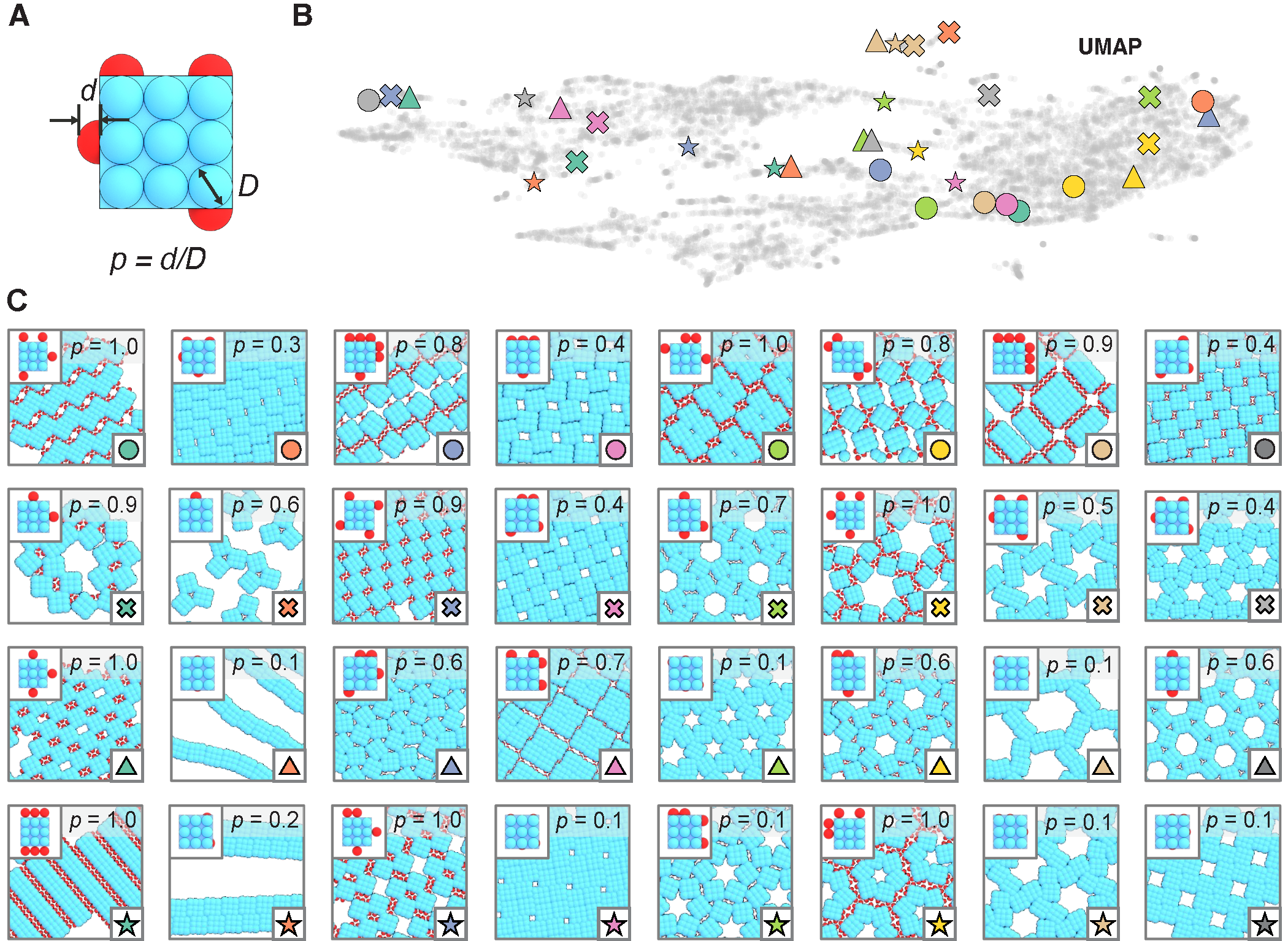
Each point on the map corresponds to a specific particle design and its resulting assembly, embedded in a low-dimensional space via dimensionality reduction. Points that are close together share similar structural motifs; distant points represent distinct assembly behaviors. The map gives a global view of how design choices shape assembly outcomes across the entire accessible landscape.
The design space yields a striking variety of assemblies: ordered or disordered, chiral or achiral, finite-sized or lattice, close-packed or open structures. Even small changes in patch placement or interaction range can redirect the assembly pathway entirely.
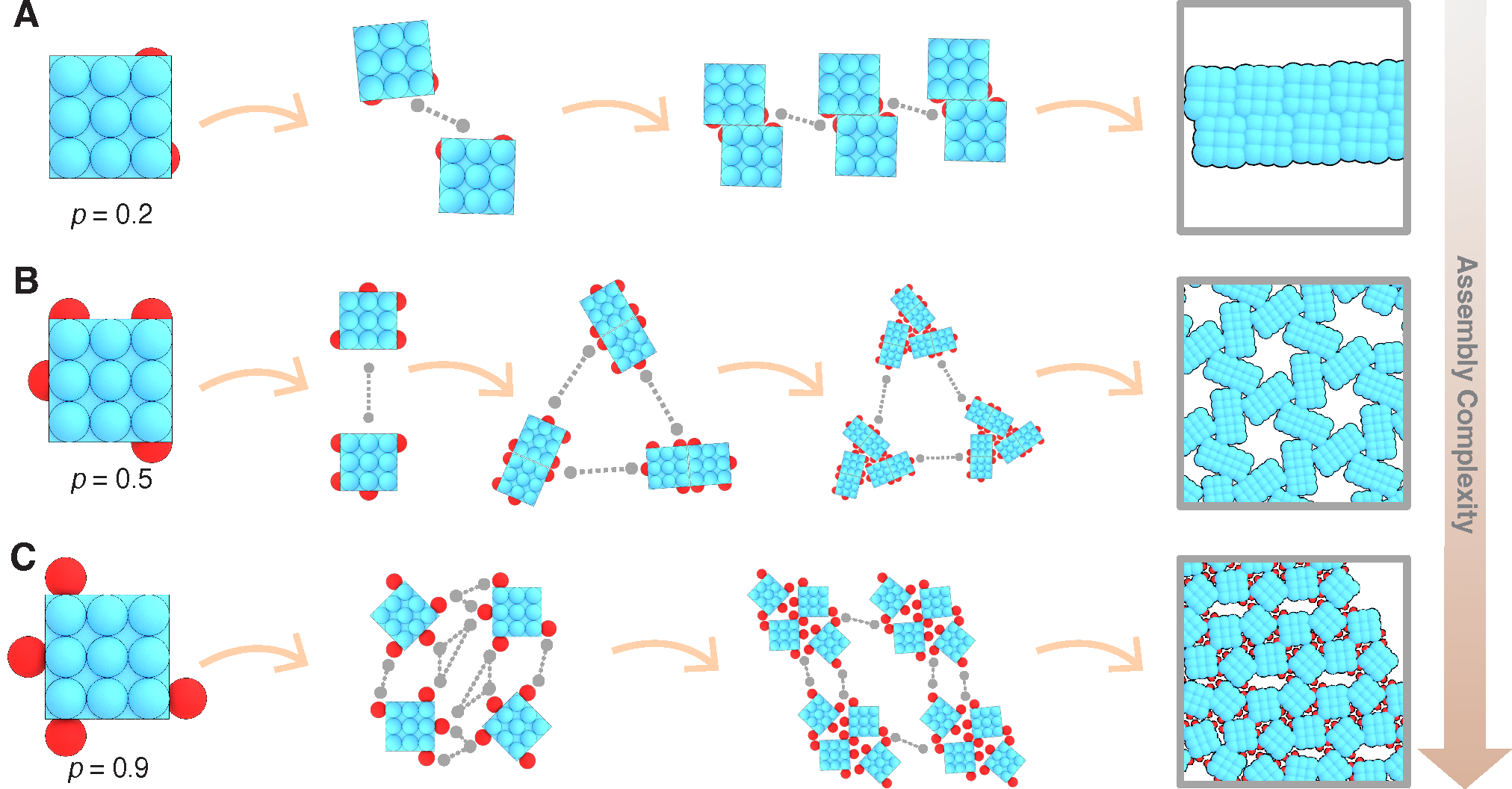
For instance, assembly can proceed hierarchically — dimers, trimers, and higher-order clusters form first, then combine into larger architectures. The same patch can play a completely different role depending on context, making outcomes highly non-intuitive.
To navigate this landscape systematically, we built an inverse design framework called the discrete neural adjoint method. It learns the forward mapping from design to structure, then uses gradient-based optimization—with a Gumbel–Softmax relaxation for differentiability over discrete patch configurations—to find designs that yield assembled structures matching a specified target. Details and code are on our GitHub.